AI-powered healthcare solutions that transform unpredictable biosignals into actionable insights enabling safer dialysis and smarter patient care.

AI-powered healthcare solutions that transform unpredictable biosignals into actionable insights enabling safer dialysis and smarter patient care.


AI-powered healthcare solutions that transform unpredictable biosignals into actionable insights enabling safer dialysis and smarter patient care.
Case Studies
Solving Intradialytic Hypotension
8–40% of dialysis sessions end with a sudden BP drop.
Each event increases cardiac stress, raises mortality risk, and disrupts treatment, yet most clinics only react after the damage is done.
15–30% of dialysis sessions end with a sudden BP drop.
Each event increases cardiac stress, raises mortality risk, and disrupts treatment yet most clinics only react after the damage is done.
Code
1
2
3
4
5
class NexevUFRModel:def __init__(self):self.model = "LSTM"self.status = "ready"def predict_idh(self, hemodynamic_data):"""Takes real-time hemodynamic signals (BP, HR, UFR)and predicts risk of intradialytic hypotension (IDH)before it happens."""risk_score = self.model_forward_pass(hemodynamic_data)return risk_scoreNexev Approach
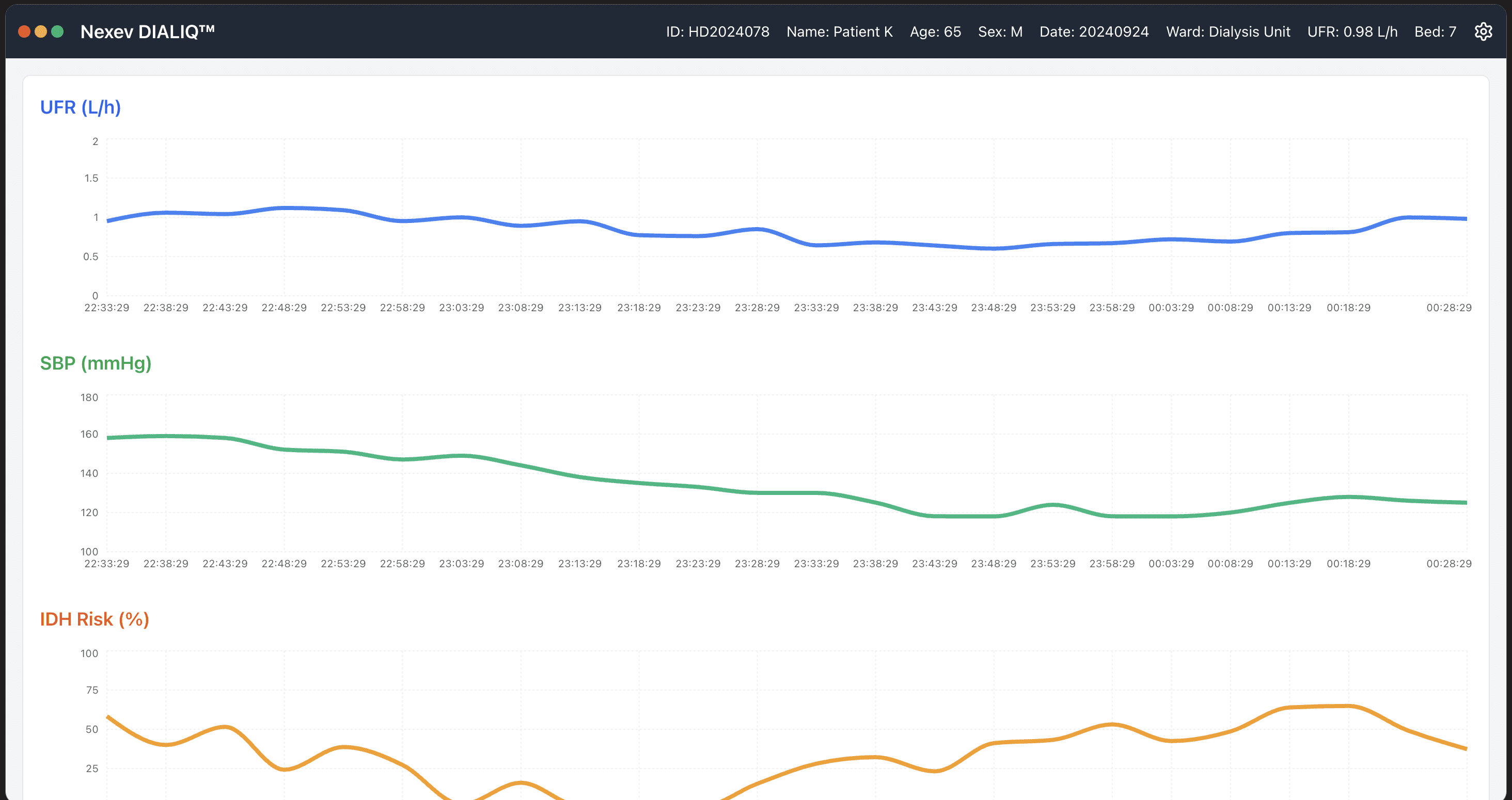
Nexev continuously predicts intradialytic hypotension minutes before onset and dynamically adjusts the ultrafiltration rate.
Standard Practice
Current practice relies on manual, retrospective UFR adjustments, with intervention initiated only after a significant decline in blood pressure is observed.
Code
1
2
3
4
5
class NexevUFRModel:def __init__(self):self.model = "LSTM"self.status = "ready"def predict_idh(self, hemodynamic_data):"""Takes real-time hemodynamic signals (BP, HR, UFR)and predicts risk of intradialytic hypotension (IDH)before it happens."""risk_score = self.model_forward_pass(hemodynamic_data)return risk_scoreNexev Approach
Nexev continuously predicts intradialytic hypotension minutes before onset and dynamically adjusts the ultrafiltration rate.
Standard Practice
Current practice relies on manual, retrospective UFR adjustments, with intervention initiated only after a significant decline in blood pressure is observed.
Code
1
2
3
4
5
class NexevUFRModel:def __init__(self):self.model = "LSTM"self.status = "ready"def predict_idh(self, hemodynamic_data):"""Takes real-time hemodynamic signals (BP, HR, UFR)and predicts risk of intradialytic hypotension (IDH)before it happens."""risk_score = self.model_forward_pass(hemodynamic_data)return risk_scoreNexev Approach
Nexev continuously predicts intradialytic hypotension minutes before onset and dynamically adjusts the ultrafiltration rate.
Standard Practice
Current practice relies on manual, retrospective UFR adjustments, with intervention initiated only after a significant decline in blood pressure is observed.
Code
1
2
3
4
5
class NexevUFRModel:def __init__(self):self.model = "LSTM"self.status = "ready"def predict_idh(self, hemodynamic_data):"""Takes real-time hemodynamic signals (BP, HR, UFR)and predicts risk of intradialytic hypotension (IDH)before it happens."""risk_score = self.model_forward_pass(hemodynamic_data)return risk_scoreNexev Approach
Nexev continuously predicts intradialytic hypotension minutes before onset and dynamically adjusts the ultrafiltration rate.
Standard Practice
Current practice relies on manual, retrospective UFR adjustments, with intervention initiated only after a significant decline in blood pressure is observed.
DRAG TO EXPLORE
Collaborating at a clinician level with

DIALIQ™
Predictive Dialysis Care
DIALIQ™
Dialysis Care
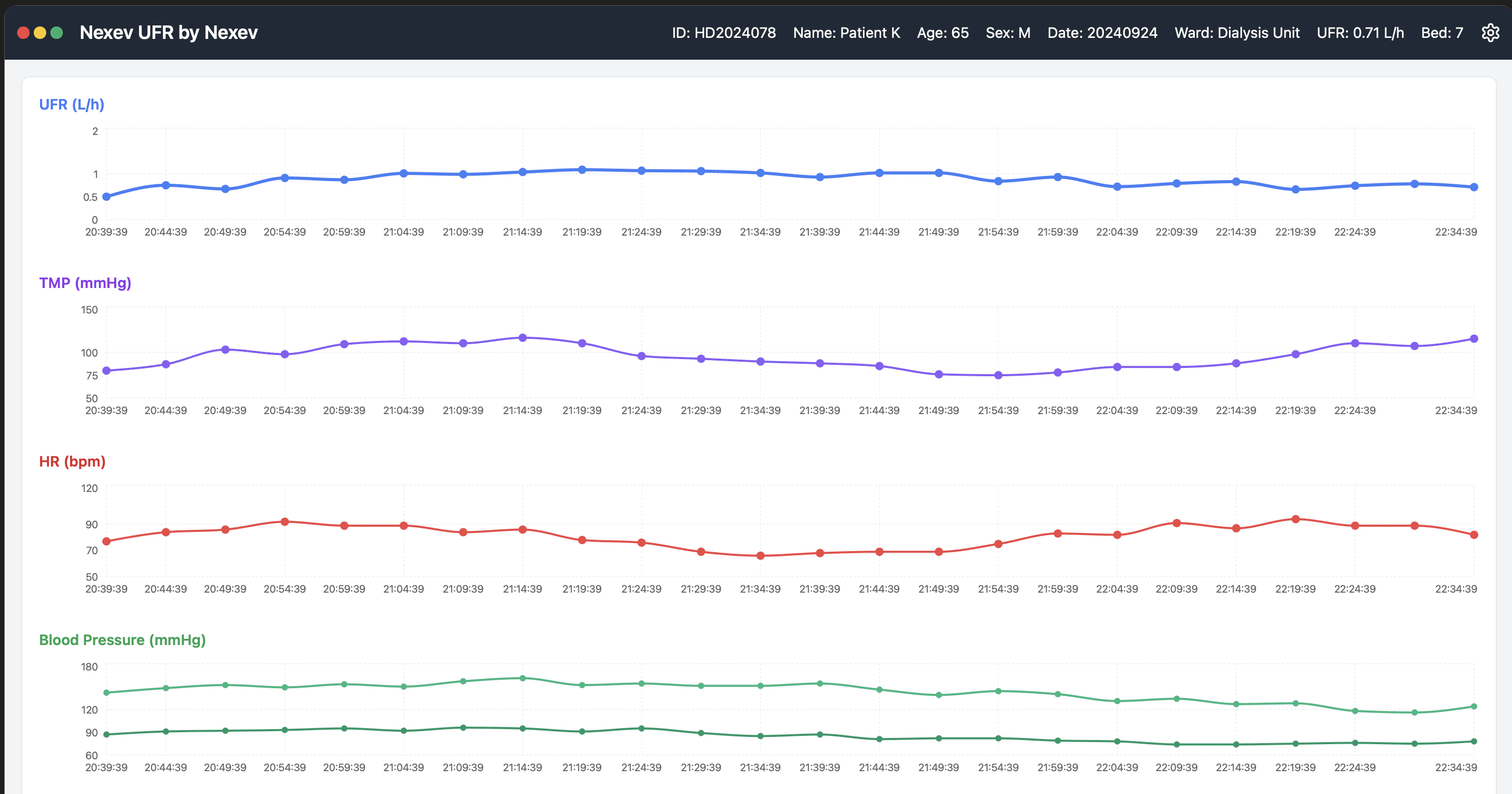
Continuously monitors live patient data, predicts intradialytic hypotension minutes before onset, and dynamically adjusts ultrafiltration
Our Process
Designed for reliability, safety, and clinical impact
We transform raw dialysis data (BP, HR, UFR) into actionable intelligence ensuring safer fluid removal and better patient outcomes.
Step 1
Clinical Data Collection
Collecting multi-parameter dialysis data (blood pressure, heart rate, UFR, and machine settings) in a secure, compliant manner to build a robust foundation for predictive modeling.
Gathering Data..
Blood Pressure
Filtration Rate
Patient Weight
Dialyser Type
Blood Flow
Gathering Data..
Blood Pressure
Filtration Rate
Patient Weight
Dialyser Type
Blood Flow
Step 2
AI Development
Our LSTM-based algorithm is trained on real-world retrospective clinical datasets. The model predicts intradialytic hypotension minutes before onset, enabling proactive intervention.
- class UFRPredictor(nn.Module):def __init__(self, input_size=11):super().__init__()self.lstm = nn.LSTM(input_size, hiddenbatch_first=True)self.fc = nn.Linear(hidden_size, 1)def forward(self, x):out, _ = self.lstm(x)return torch.sigmoid(self.fc(out[:, -1, :]
- class UFRPredictor(nn.Module):def __init__(self, input_size=11):super().__init__()self.lstm = nn.LSTM(input_size, hiddenbatch_first=True)self.fc = nn.Linear(hidden_size, 1)def forward(self, x):out, _ = self.lstm(x)return torch.sigmoid(self.fc(out[:, -1, :]
- class UFRPredictor(nn.Module):def __init__(self, input_size=11):super().__init__()self.lstm = nn.LSTM(input_size, hiddenbatch_first=True)self.fc = nn.Linear(hidden_size, 1)def forward(self, x):out, _ = self.lstm(x)return torch.sigmoid(self.fc(out[:, -1, :]
- class UFRPredictor(nn.Module):def __init__(self, input_size=11):super().__init__()self.lstm = nn.LSTM(input_size, hiddenbatch_first=True)self.fc = nn.Linear(hidden_size, 1)def forward(self, x):out, _ = self.lstm(x)return torch.sigmoid(self.fc(out[:, -1, :]
Step 3
Seamless System Integration
A fully functional GUI is ready for real-time monitoring and UFR adjustment simulation. API integration is in progress, enabling easy deployment into dialysis workflows and EHR systems.
Nexev API

Dialysis Machine
Nexev API
Dialysis Machine
Step 4
Real-World Testing & Iteration
We are preparing a prospective pilot study with nephrologists to measure patient outcomes. The model will be continuously refined using clinician feedback and outcome data — ensuring safety, accuracy, and regulatory compliance
Pilot Study Ongoing
Prospective validation with real patient sessions.
Feedback Loop Active
Clinician feedback drives model refinement.
Regulatory Ready
Designed for HIPAA & GDPR compliance.
Pilot Study Ongoing
Prospective validation with real patient sessions.
Feedback Loop Active
Clinician feedback drives model refinement.
Regulatory Ready
Designed for HIPAA & GDPR compliance.
Step 1
Clinical Data Collection
Collecting multi-parameter dialysis data (blood pressure, heart rate, UFR, and machine settings) in a secure, compliant manner to build a robust foundation for predictive modeling.
Gathering Data..
Blood Pressure
Filtration Rate
Patient Weight
Dialyser Type
Blood Flow
Gathering Data..
Blood Pressure
Filtration Rate
Patient Weight
Dialyser Type
Blood Flow
Step 2
AI Development
Our LSTM-based algorithm is trained on real-world retrospective clinical datasets. The model predicts intradialytic hypotension minutes before onset, enabling proactive intervention.
- class UFRPredictor(nn.Module):def __init__(self, input_size=11):super().__init__()self.lstm = nn.LSTM(input_size, hiddenbatch_first=True)self.fc = nn.Linear(hidden_size, 1)def forward(self, x):out, _ = self.lstm(x)return torch.sigmoid(self.fc(out[:, -1, :]
- class UFRPredictor(nn.Module):def __init__(self, input_size=11):super().__init__()self.lstm = nn.LSTM(input_size, hiddenbatch_first=True)self.fc = nn.Linear(hidden_size, 1)def forward(self, x):out, _ = self.lstm(x)return torch.sigmoid(self.fc(out[:, -1, :]
- class UFRPredictor(nn.Module):def __init__(self, input_size=11):super().__init__()self.lstm = nn.LSTM(input_size, hiddenbatch_first=True)self.fc = nn.Linear(hidden_size, 1)def forward(self, x):out, _ = self.lstm(x)return torch.sigmoid(self.fc(out[:, -1, :]
- class UFRPredictor(nn.Module):def __init__(self, input_size=11):super().__init__()self.lstm = nn.LSTM(input_size, hiddenbatch_first=True)self.fc = nn.Linear(hidden_size, 1)def forward(self, x):out, _ = self.lstm(x)return torch.sigmoid(self.fc(out[:, -1, :]
Step 3
Seamless System Integration
A fully functional GUI is ready for real-time monitoring and UFR adjustment simulation. API integration is in progress, enabling easy deployment into dialysis workflows and EHR systems.
Nexev API
Dialysis Machine
Nexev API
Dialysis Machine
Step 4
Real-World Testing & Iteration
We are preparing a prospective pilot study with nephrologists to measure patient outcomes. The model will be continuously refined using clinician feedback and outcome data
Pilot Study Ongoing
Prospective validation with real patient sessions.
Feedback Loop Active
Clinician feedback drives model refinement.
Regulatory Ready
Designed for HIPAA & GDPR compliance.
Pilot Study Ongoing
Prospective validation with real patient sessions.
Feedback Loop Active
Clinician feedback drives model refinement.
Regulatory Ready
Designed for HIPAA & GDPR compliance.
Impact of DIALIQ™ on Patient Outcomes
Improve Haemodynamic Stability
DIALIQ analyses live dialysis signals to detect early signs of IDH. This early insight supports steadier blood pressure control, reducing symptomatic drops and improving treatment tolerance.
Improve Haemodynamic Stability
DIALIQ analyses live dialysis signals to detect early signs of IDH. This early insight supports steadier blood pressure control, reducing symptomatic drops and improving treatment tolerance.
Improve Haemodynamic Stability
DIALIQ analyses live dialysis signals to detect early signs of IDH. This early insight supports steadier blood pressure control, reducing symptomatic drops and improving treatment tolerance.
Reduce Sudden Cardiovascular Risk
By minimising rapid blood pressure declines, DIALIQ reduces cardiac stress and supports safer long-term cardiovascular outcomes.
Reduce Sudden Cardiovascular Risk
By minimising rapid blood pressure declines, DIALIQ reduces cardiac stress and supports safer long-term cardiovascular outcomes.
Reduce Sudden Cardiovascular Risk
By minimising rapid blood pressure declines, DIALIQ reduces cardiac stress and supports safer long-term cardiovascular outcomes.
Where We Are Now
MVP Ready
Beta Preparation Underway
Beta Preparation Underway
Preparing API integration and clinical pilot study with nephrologists.
Validated AI model and functional GUI Now preparing API integration and clinical pilot study with nephrologists.
Tasks
Validation Steps
Data Collection
1200+ data collected
Feature Engineering
BP, HR, UFR slopes & delta values extracted
Model Training (LSTM)
Training completed on retrospective dataset
Performance Metrics
AUROC: 0.75 | AUPRC: 0.38
Clinical Review
Validated with nephrologists’ feedback
Tasks
Validation Steps
Data Collection
1200+ data collected
Feature Engineering
BP, HR, UFR slopes & delta values extracted
Model Training (LSTM)
Training completed on retrospective dataset
Performance Metrics
AUROC: 0.75 | AUPRC: 0.38
Clinical Review
Validated with nephrologists’ feedback
Model Validation
Retrospective Validation
Our AI model (LSTM) has been trained and validated on retrospective clinical data, achieving strong AUROC and AUPRC scores.
High AUROC
Clinically Validated
GUI & Pilot Prep
Functional GUI
Built a fully functional GUI for real-time monitoring and UFR adjustment simulation. API integration is next, followed by a prospective pilot study with nephrologists.
Real-Time Monitoring
API-Ready
Real-Time Monitoring
Model Validation
Retrospective Validation
Our AI model (LSTM) has been trained and validated on retrospective clinical data, achieving strong AUROC and AUPRC scores
High AUROC
Clinically Validated
GUI & Pilot Prep
Functional GUI
Built a fully functional GUI for real-time monitoring and UFR adjustment simulation. API integration is next, followed by a prospective pilot study with nephrologists.
Real-Time Monitoring
API-Ready
Real-Time Monitoring
Request Early Access to Nexev
Be among the first dialysis centers to test AI-guided, real-time UFR optimisation. Let's make dialysis safer — together
Request Early Access to Nexev
Be among the first dialysis centers to test AI-guided, real-time UFR optimisation. Let's make dialysis safer — together
+61 0415256402
founder@nexev.co